
Embrace the Suck
Embrace the Suck
Embrace the Suck
Some of my earliest memories are of living in a travel trailer – an old silver bullet-shaped one. It wasn’t as hip as an Airstream or anything. I slept in the tiny bedroom at the back and my brother crawled into a little nook my dad built into the hallway. My parents slept on a green fold down couch in the living room. We towed the trailer up to very rural Wyoming to follow an oilfield boom where my dad worked as the derrick hand, scaling the rig to the top. I remember running around with the trailer park kids, my mom shouting out the door when dinner was ready. Although they weren’t living in RV’s like us, lots of our neighbors were probably following seasonal jobs or trying to find their economic footing. Living in that trailer gave my parents what they needed at the time – cheap housing, a pathway into home ownership and the ability to follow jobs wherever they opened up.
It used to be that mostly retirees owned RV’s, people over 65. But since the pandemic, that has changed. Now over half of RV owners are Millennials and Gen Zers. And it’s not a minor demographic shift. RV ownership is growing fast. It’s increased 62% in the last 20 years. Over 11 million families own one these days. The housing crisis in the U-S has also gotten significantly worse in that same time period. People aren’t just vacationing in RVs anymore. They’re moving in and calling them home sweet home.
One of those people making that choice is Kevin Cox. He’s a house builder who doesn’t have a house of his own. Kevin lives a few miles outside of Laramie, Wyoming, the city where I’m from. Turns out he built the homes of two of my good friends and they put me in touch. I ask if I can come hear his story and he says, sure, come on out. So on a frosty morning under a brilliant blue sky in the middle of winter, I head out to visit a guy living in his camper.
Driving down his long driveway I marvel at his luck to own this piece of the Laramie Valley. Kevin bought this property – 24 acres of sagebrush and gigantic views – for only $25,000 dollars about 20 years ago. Nowadays, that much land could cost four or five times as much. Albany County, where we live, has one of the worst affordable housing shortages in our state. That’s because we host the one and only university in Wyoming and the demand for low-cost student housing is fierce. We have lots of folks making less than $25,000 a year and that means we have the largest gap in the state between rental needs and rental availability. I’ve seen a family living in a school bus, a guy parking around town in a motor home, a new tiny house on my way to work. So yeah, Kevin’s a lucky guy. 24 acres of wide open space only a few miles from town. I pull up and Kevin and his border collie both come grinning out to greet me.
“Howdy!” I call. “Who's this?”
“This is Boo,” says Kevin.
“Hi, Boo. Ah, some nice sniffing sounds. I like that. I'm Melodie.”
“Hi, Kevin. Nice to meet you.”
“Nice to meet you too.”
It’s late January when I visit, and just warming up after some intensely cold temperatures the day before. Some of Kevin’s building equipment on his property took a beating.
“I lost two generators and then the one that's running right now went down because it got snow packed. So we had to melt it all out and clean it up and go. So yeah, the Bobcat went down and so we pulled her in, warmed her up, got her going again.”
“How cold did it get out here?” I ask.
“I think it was 20 below out there with the wind chill.”
It was so cold outside that one of his generators can’t be fixed and he’ll have to buy a new one. You’d think something like this might give Kevin pause about living out here. But he’s a philosophical guy.
“I did order another generator, which I wanted to do anyway, but, yeah, it's all good.
You can't worry about little things. You just gotta go. That's all there was to it.”
He’s got everything running off grid out here using large solar panels and a propane tank.
“ So are you pretty much on solar then out here?” I ask.
“Yeah. It's tremendously expensive to get from over there to here. So yeah, off grid batteries are in there. I built this in that shed for protection and stuff to get it away from everything. And then we have, in the summer. It works out really good. We'll start the generator for tools for the big stuff, but other than that, I can run off batteries. And then, winter it's a different story, so the generator kind of has to run, but other than that, we're good.”
He takes me on a tour of his gigantic shop. It’s a canvas sided structure with a big heater inside. We climb up to the loft inside – an upstairs that looks down onto the shop below – where there’s a window with an incredible view of the valley and the Snowy Range mountains beyond. His property sits on the rim of the Big Hollow – a geological formation, a large bowl-shape in the prairie carved by the wind funneling between mountains nearby. Sometimes with hurricane force gusts.
“It whips out,” Kevin says. “There's nothing to stop it so it can really roll. So you get it. It's a part of the beauty of it. The sunrises and sunsets make up for it. Because you get to see everything, the stars at night, the moon at night, everything. So, that's fantastic. That's beautiful.”
Right now, Kevin has several woodworking projects underway up in this loft but…
“ I was gonna put an apartment in here and live out of this. And just ran out of time. So I bought a fifth wheel, so that was cool.”
He bought the fifth wheel RV and, at first, put it inside this shop. But then he needed the room for his construction business and moved it outside.
“ It works, and it's not pretty, but it works, and it's mine. That's the best part about it is it's paid for. The funny thing is that the stuff that I build for me, I just throw up so fast. So it's not pretty. It's embarrassing almost, when I look at my work compared to what I do for my customers, to me, because I just don't have the time, so sometimes I just have to do it. And then I laugh.”
It’s a theme I begin to notice with Kevin. He’s got a million projects going at once:
“ I want to start sculpting and stuff and mess around…
“This has been fun. You can see I got a couple doors….
“And then I'm fixing the chair for a guy too, so that's kind of fun….
“ Look at this. The Big Foot bench!”
“Oh, that's got feet on it!” I say. “They even have painted toenails!”
“Camouflage toenails,” says Kevin. “For Bigfoot…”
“Yeah, I got a little greenhouse.
“What do you grow out here?” I ask.
“Well, a little bit of everything,” says Kevin. “Herbs, tomatoes. So these are like peppers. I tried corn out in front. That didn't work.”
He also has this extra ambitious project to share this land with local artisans.
“Rather than building a house on this now, I'm going to put a couple of buildings out here. And I'm gonna open it up to some artisans. So, my goal is to build this place as kind of an art community and trades community. And then showcase their stuff in a building on the corner. So that we can capture the people that drive on this road.”
He points out at the highway where he pictures the commercial storefront he’ll construct there for artists to sell their wares. He’s happy to share this space. His employee lives in an RV out here too. Off gridders are dreamers at heart. And willing to take risks for those dreams. One of the things Kevin loves best about house building is the freedom he feels clambering around on them. But it’s a safety risk too. He tells me a story about breaking four ribs while building my friend Leah’s house.
“Oh no, really? How'd you do that?”
“Yeah, it was fun,” says Kevin. “Well, I got in a hurry. And I built a header and then, I actually rolled a bunch of joists for upstairs. And I looked at the header and I didn't like it, so I pulled it out. And then it started raining. I forgot to put it back in. So one of the joists, there was nothing carrying it. And I was all fired up to throw sheets that day. And I was working by myself. And, got up there to snap a line and started walking across those things. Yeah, it went through. And I hit the next one, wrapped around it and dropped to the concrete. And the wind was just knocked out of me.”
But it didn’t make him think twice about climbing back up there as soon as he was able.
“That's part of the deal. Well, yeah, it was part of the fun too. Crawling around on everything and enjoying the freedom to do it. I'm probably not safe when it comes to me and crawling on stuff and getting in the air because I love getting in the air. Could be my nemesis, but it's that freedom as a carpenter that you like. And that's a part of the business is you like to take maybe a little chance here, a little chance there. And the consequence is gravity.”
It’s a good metaphor for off gridding writ large. The risks we all take for that feeling of freedom. A little chance here, a little chance there. Sometimes that pays off and you get to live the good life. But sometimes, the consequences are dire. Oh, how I remember that mentality, the addiction to that risk taking. But luckily, Kevin isn’t out here doing this totally alone. On our tour, I watch his employee peeling logs in another shop with a greenhouse on the side. A giant log straddles a piece of equipment that fills the length of the building.
“We're hand peeling them. He'll cut this up, make siding out of it and then, put it on here, cut it to width and then we'll ship it out here. And peel.”
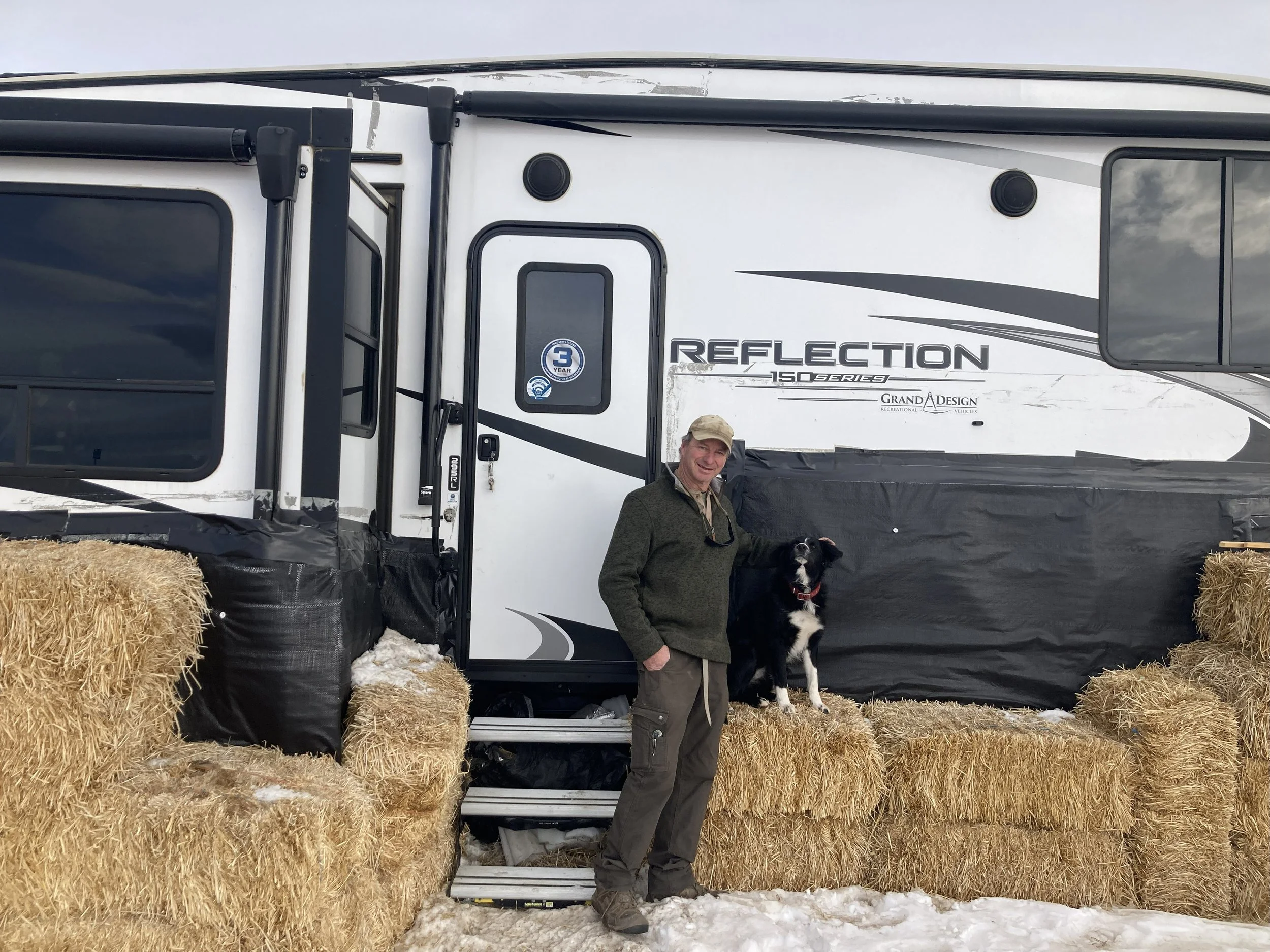
After we see the log peeling, we head over to Kevin’s RV. These days, it’s parked on the south side of his large shop next to the solar panels. Instead of traditional skirting, he’s got hay bales surrounding it to keep the wind from blasting in through the floor.
“I tried a couple different things and it seems like the hay bales work out the best,” says Kevin. “I wrapped it last year out of concrete blankets. It worked out pretty good but I think it was overkill.”
“Wow, it’s spacious!” I say.
A cat meows. “That’s Tank,” Kevin says.
“Hi kitty kitty.”
It’s a newer model of RV with stylish cabinets and all the fixtures of a regular house. By way of a tour, he sweeps his hand around.
“Well, you see my clothes and they're scattered all about, my little clothes pile. Guitar that I never get to play. But, yeah, it's simple. The construction of this place is nice, and we've got a couple pop outs, which gives me more room. I do have a TV, and I think it works, but I don't know. So, then there's a little electric fireplace down here, too, that actually kicks off some pretty good heat if need be. I had to use it last year when it got cold-cold.”
It was bitter cold this week too but he didn’t use the fireplace. Kevin, Boo and Tank stayed warm and toasty in the RV with a furnace powered by propane.
“We're linked to power, so I have to have the batteries going. And the batteries make it through the night. So we run the generator when we're running all the stuff, and then shut it off. And the batteries make it through the night, so that's really cool. You get peace and quiet and stuff. Once you live out of town, it's really hard to go back into town. Even with generators breaking, even with water freezing, whatever.”
Like most people I interviewed for this podcast, it’s hard to pin Kevin down about whether he made this choice more for financial reasons or for the freedom of the lifestyle. Even I can’t say which came first for Ken and me. A few years back, Kevin did own a house in Laramie with a girlfriend. But after that, he lived in an apartment over a shop in town. But when that situation changed, he needed somewhere else to live.
“It was just quicker to buy this than build. Because most of the time I don't have the time to do stuff for me. I'm always busy doing stuff for everybody else. So just circumstances, but it worked.”
“Are you feeling like by living this lifestyle, you're being able to save money and like you have the ability to act on some of those plans?” I ask.
“Yeah, I do pretty good. Um, yeah,” says Kevin. “Uh, until, uh, everything breaks down. So, you have to take the good with the bad. And, uh, I try to keep a stockpile. Now my stockpile has dwindled because it's been a tough – a tough year. But that's okay. It's just a part of it.”
“A tough week, even.”
“Oh, yeah. Yeah. Spent a little money this week.”
Kevin says the first winter he lived in the RV, he learned some hard lessons.
“ I didn't get out here until December. So it was go-time right off the bat to try to survive through that winter. But I changed the oil on one of my generators, like one o'clock at night in a snow storm in my jammies. You're out there bundled up and trying to get things going again. So I had to laugh about that.”
Kevin doesn’t have a well out here. The RV has a 200 gallon tank but he doesn’t use it because the pipes would freeze.
“ I go into town to shower, but I boil all my water and then that's how I do my dishes. Boil my water and do that.”
It’s the exact same method Ken and I used when we lived in the canvas geodesic dome in Arizona. Lugged five gallon jugs of water out and heated it up in a teapot for sponge baths and then took real showers at our friend’s house. Like us, Kevin doesn’t have a septic tank. But he’s smarter than we were and brought out a port-a-potty. It’s the lack of a septic tank that sometimes gets off gridders in trouble. They’re expensive so people try to forgo them and then get caught. But Kevin hasn’t had any hassles from officials coming around asking questions.
“ You want to keep government away from you, for sure, but there's also checks and balances, and how that fits together. Because if you sell it afterwards and it's not to par, then who's responsible for that? But, yeah, you want to be left alone and it's a sticky situation.”
Kevin thrives on that feeling of self reliance.
“You're your own person, and you're responsible for yourself, and you have to make decisions now. There's no calling anybody, it's you and mother nature. So you have to be prepared for the good and the bad, and embrace it. And that's the best thing is not everybody can do it. And not everybody could live like this in the winter and giggle at the snow storms and freeze to death and embrace it and be a part of it. Boil their water. You've done it. I mean, it's cool, but I could hook this up and have running water, but I don't because I don't want to. It's just one more, ‘Oh, crap’ that I'd have to worry about.”
Kevin recognizes this lifestyle isn’t for everybody. It’s not a solution that can solve the underlying housing problem. But it works for him.
“ There's a mentality too that has to go along with it. So it might sound fun to live off the grid, but until you see that snow whipping by, and the storm’s coming on you, and the wind, and the thunder. I mean, I rode some stuff out in my trailer that probably wasn't too smart, but I'm like, ‘Whoa, here we go,’ and you kind of laugh at it and go at it.”
“Are you seeing people kind of give it up?” I ask.
“Yeah, I had a buddy of mine that lived down the street that went back to Florida,” says Kevin. “He was out here for three or four years and he was in the Hollow. So getting out of the Hollow is tremendously difficult.”
“Just the road is bad?” I ask.
“Yeah. In the snow. So, yeah, he threw his hands up and left, went back. Now he's soaking up the sun, living the good life.”
But Kevin isn’t tempted to leave his 24 acres of land on the edge of the Big Hollow. To him, this is the good life. He has advice for wanna-be off gridders:
“I'd say mostly that you'd have to have a good strong positive attitude and can't let the little things get to you. Do the best you can, but you know that you're kind of getting your butt kicked anyway at some point. So, embrace the suck.”
When I lived this life, it was by the seat of my pants. Back then, our cell phone was the size of a brick and we had to climb a hill to get a signal to call if we ever needed help. Like the time we came home to find our puppy bitten in the face by a rattlesnake and had a 45 minute drive on evil roads to the nearest vet. But I also agree with Kevin when he says there’s something satisfying about surviving that kind of thing. For the rest of your life, you know what you’re capable of.
“ In order to live outside, it takes grit. And it takes the love for the land. It takes the antelope. I take care of the antelope. I'd like to think I do. And the rabbits, take care of them, the birds. I like that. I enjoy that. I've seen elk out here walk by, moose. So, to paint a picture of just happy glee all the time would be a wrong path to take. But if you know it's coming, and you embrace it, and laugh at it, and laugh at yourself, then you'd have a shot.”
Over the summer I notice that Kevin’s RV isn’t out by his shop anymore. So I reach out to see what he’s up to. He texts back and tells me quote “Pulled it to a camp spot for the summer. I’m still alive. Ha.” The perks of living in a home on wheels. You can follow your whims where they lead. And one thing you can say about Kevin Cox, he’s got plenty of whim
MUSIC ATTRIBUTION:
Hollow Grove (Instrumental Version) by Josh Woodward is licensed under a Creative Commons Attribution License.
I Will Not Let You Let Me Down (Instrumental Version) by Josh Woodward is licensed under a Creative Commons Attribution License.
Private Hurricane (Instrumental Version) by Josh Woodward is licensed under a Creative Commons Attribution License.
Little Tomcat (Instrumental Version) by Josh Woodward is licensed under a Creative Commons Attribution License.
Water in the Creek (Instrumental Version) by Josh Woodward is licensed under a Creative Commons Attribution License.
We usually think of full-time RVers as retirees. But these days, over half are Millennials and Gen Zers. And way more people are adopting the RV life. Including Kevin Cox, a house builder who doesn’t have a house of his own. Instead, he lives in his camper on the edge of Wyoming’s Big Hollow. He says, off-gridding isn’t for the faint of heart.