
The American Spirit
The American Spirit
The American Spirit
With affordable housing getting scarcer and scarcer, even those old singlewides stuck out in the prairie can start to look pretty darn good. And I’m not joking around here. When you look at the numbers, folks in the American West are relying on single and double wide mobile homes heavily. Six of the top 20 states with the highest numbers of trailer dwellers are in the American West. New Mexico has the most…15 percent of homes there are modular. Wyoming is eighth with trailers accounting for 11 percent of the homes. North and South Dakota, Idaho, Montana, Arizona…they’re all in the top 20.
But there’s some serious downsides to owning those older trailers. My parents currently live in a 1970’s doublewide. They can’t sell it because no bank will give a buyer a loan. In other words, they don’t hold their value like a stick built house. Lots of communities have outright banned mobile homes and often you can’t even get a title proving ownership. And laws make it a lot easier to evict people who live in mobile homes. Then there’s the problems of living in the really old mobile homes. My parent’s place needs a roof badly but they can’t afford one or get a loan for one. So my dad hauled a bunch of tires up there to keep it from flying off in the intense winds they get on their ridge. And it’s not just roofs. The electrical in old trailers is often downright dangerous. And a lot of times they don’t have insulation against the frigid winter of the Rocky Mountains.
But with homes so hard to find these days, a mobile home IS still a roof over your head. And with the housing shortage only worsening, lots of people are just plugging their nose and jumping in. And sometimes it does work out. People can get a piece of open space where they can raise some ducks and chickens…and it can be good transitional housing while you build your dream home. For Casey Bruder, a trona mine employee who always dreamed of building his own cabin off grid in the wild, that’s exactly what his 1970’s singlewide trailer is offering him …and the two small children he’s raising by himself.
It isn’t easy finding a good time to visit Casey and his family. We have to get up well before dawn. My photographer and I drive way out into the Red Desert east of Rock Springs, Wyoming. We want to visit them before the kids catch the bus and Casey heads to the trona mine for work. The navigation app struggles to give us accurate directions.
“Turn right,” it says.
“She wants us to just drive out into the prairie,” I chuckle.
But finally we arrive. The winter night sky feels so close you could run your fingers through it. But a cozy glow emanates from inside the trailer…all of it powered by solar panels. The Bruder home isn’t just off grid – it’s way off grid. We knock and set the dogs barking.
“ Hi, it’s Melodie. Nice to meet you in person. I’m Melodie. And this is my photographer, Hannah. Thanks for having us out. I appreciate it.”
“A little chilly out there, eh?” Casey says.
“Yeah, a little bit, but not as bad as yesterday. It was so windy,” I say.
“Yeah. When the wind kicks up is when it gets bad.”
This morning, Casey is already putzing around the kitchen. He sports a goatee and long brown hair parted in the middle and pulled back in a long ponytail that goes all the way down his back. He has an hour-long drive to get to his job as a specialist controlling the automation at a local trona refinery. If you don’t know what trona is, well, it’s Wyoming’s biggest export and after they grind the mineral up, they use it to produce lots of products you use every day like deodorant, glass bottles, laundry detergent…. But Casey also has to get up extra early because he has more than the usual stuff to do to get his kids ready. His six-year-old daughter Gracelynn has health issues related to Down’s syndrome.
“I get up at 5:30 just to get– my daughter has a G tube, a gastro tube,” says Casey. “So she has to have a pump. She takes all her liquids via this tube in her belly. She can't drink without aspirating. So I get up at 5:30 in our starter pump, which is an hour process. And it just gives her her first set of liquids through the day. And then I have to do the same thing at night. And then I've got these syringes here. She takes eight pills, and I have to dissolve those in water. So you got to give them time to dissolve well, so that they'll go through the tube correctly.”
Gracelynn is still fast asleep. But it doesn’t take long for his eight year old son Thane to wander out in his pajamas. Casey tries to get Thane motivated to get ready.
“ All right. Come here kid,” says Casey. “Let's get your teeth brushed and your hair brushed real quick.”
But Thane really wants to show us his latest project. A ceiling fan he built. Like his dad, he loves all things mechanical. Like, really, really loves it.
“What's that thing?” I ask.
“ It's a ceiling fan,” says Thane.
“It is? Did you make it?”
“Yeah, it actually works, too.”
“Really? Wow, that's cool.”
“I was taking it down to fix this blade.”
Thane also gives us a tour of his cardboard box fort that is on grid in this off grid trailer. It has its own overhead lighting.
“ His first love in life was vacuum cleaners,” Casey says. “He learned to crawl to chase the room duster. So he did a period where he's obsessed with vacuum cleaners and then fans, sirens, which was unfortunately…”
Loud,” I guess.
“Yeah,” says Casey, laughing.
Casey tries to get Thane to eat a bagel for breakfast.
“Okay,” Casey says. “Eat this so you don't drop it on the bus.”
“I know I always drop these bagels every couple seconds,” Thane says. “Especially in the car.”
“Yeah. Eat one now, so you don't have to try and hold 'em both while we're driving.”
“Okay. I'll eat.”
But even this bagel requires some extra consideration. It’s the middle of February when there’s not so much solar power and Casey needs it to run Gracelynn’s medical equipment …not to mention keep the place warm.
“Yeah, this is one of the things with the off grid, like, a toaster, coffee maker, things like that,” Casey says. “When you get those really short days and it's really cold out, you're running the heater a little more. I can't run any of that kind of stuff because you get the short days and it's cloudy and snowy all day. So I will run the kettle or something, or even heat it up on the wood stove.”
Casey hears Gracelynn stirring and heads to the back bedroom to get her dressed.
And who is this?” I ask.
“This is Gracelynn,” Casey says.
“Hi Gracelyn.”
“Thane, he'll go to bed on his own at eight o'clock and then he is up at 5:00 AM even on the weekends when I try and sleep in,” Casey says. “Gracelynn, she'll stay up till 10 or 11 at night. You just can't get her to sleep and she'd sleep half the day.”
Gracelynn sits on the kitchen counter while Casey gets her medications administered. The clock is ticking.
“See, here's your alarm, kiddo,” Casey says. “Time to get going. Did we get all your homework put back in here?”
Now Thane is ready to go but Casey still needs to braid Gracelynn’s long blond hair. He sits down with her next to him on the couch. Then as gently as he can, combs the tangles out and braids her hair.
“This is her least favorite activity.”
They don’t want to miss the school bus that picks them up a mile or so away.
“Get in the car, kid. Come on, Gracelynn,” Casey says. “ Grab your other half a bagel. Did you eat your first half?”
“No,” Thane says.
“Come on. Go out the other door,” Casey says. “We’ll figure it out. Come on. Go, go, go. Go, we’re late.”
They’re off to school and it’s only just starting to get light outside.
After he drops off the kids, Casey comes back to the house. That way he can tell us the whole uninterrupted story of how the family came to be living off grid. He grew up just a few miles from here in Green River.
“Lived there my whole life except when I went to college down in Phoenix,” Casey tells me. “I actually got degrees in animation and media arts. Did that work for a little while while I was in Phoenix, but I realized that industry wasn't really for me and I didn't like the city either. I just, I hated living in the city from the minute I lived there And I didn't have anything when I came back, I didn't have any specific plans or a job or anything else. I just said, I'm going to go home.”
At the trona mine Caseyworked his way up to an automation specialist. He started making pretty good money and he and his wife bought a nice big house in the town of Rock Springs. That got them out of the rental market. Sweetwater County, where they lived, has one of the worst affordable rental unit gaps – low income renters can end up living in places that gobble up all their income. But it’s a little better than others when it comes to having more affordable homes to buy.
“But the whole time we were living in town we kept looking for land somewhere in Wyoming, right?” Casey says. “We just said, first thought was, well, let's find a cabin or a place we can build a cabin out somewhere, just a little bit of land somewhere outside. And then you start to think, well, do I want to invest that much of my money into something that I'm only going to see a couple of months a year?”
Casey is a lot like his son. He wanted to build a home with his own two hands. So they started looking for land.
“ So we were watching and watching and watching and then this this property came up and it came up on a Memorial weekend,” Casey tells me. “Posted on a Thursday like Zillow or something for anything over two acres and it posted on Thursday. We drove out on Friday and just looked around because I couldn't get a hold of my realtor at that point. She was gone through the whole holiday weekend. Tuesday morning we said we're ready to make an offer even though we hadn't officially seen it. I hadn't seen inside the house yet, but you kind of knew what you're getting from the outside, right?”
What he was getting was a 1970’s singlewide trailer. For $200-thousand dollars, a guy named Ralph sold it to him with some big old-school solar panels and a coal stove for heat. But they were also getting a heck of a lot more. Thirty five acres of high desert land at the foot of a large mountain surrounded on three sides by public lands. AND it has a year round spring that drains into a pond. Water is scarce in the desert and it attracts lots of wildlife. Lots of pronghorn. And all last spring, a herd of wild horses hung out there with a newborn colt.
“We saw them up there fighting one day. They weren’t rearing up and kicking each other, but they were biting each other's necks and just making a weird noise,” Casey says. “When I heard the noise a couple times, a little more like a scream, I was like, what is going on? And then I look up there, and yeah, they're up above the spring, and they were just biting at each other's necks.”
The family moved into the trailer with big dreams of building an earthship. That’s a house dug into the earth with walls made of tires filled with pounded sand. The front of an earthship is a greenhouse that uses all the gray water – the bath water, the dish water – that the house produces. They aspired to sustainability, living in sync with their land. Casey started collecting tires. It seemed like they’d made their dream a reality. But then, Casey’s wife began sliding into depression.
“Before Thayne was born, we had a pretty late term miscarriage and then between Thayne and Gracelynn, we had another one. She took it really hard. We both did, but we did it in different ways. And she ended up turning to alcohol and substances quite a bit,” Casey says. “We'd been married five years before we had started trying to have kids. The alcohol especially just got worse and worse and worse. We kind of thought moving out here would be a little different. And she ended up getting a DUI. She ran her vehicle off the road out here and a couple other things. We tried for a long time to make it work, but there was a couple things that were endangering the kids, and that's when I had to change.”
Now they’re divorced and Casey is raising the kids all by himself. And the plan to build an earthship started to feel unrealistic. He thought long and hard and decided to buy a log home kit instead.
Casey takes us out for a tour of the property so we can see his progress. On the way, we stop to water his chickens and ducks. He can’t waste his precious electricity on a water heater to keep their water from freezing so he has to fill it every morning. Recently a racoon killed a bunch of his chickens.
“ That big rooster, he was the first one out of the main coop that we saw. I found him dead the next morning. He must have tried to put up a fight.”
The realities of living cheek to jowl with mother nature.
“We can go look at the solar stuff,” says Casey.
Okay. Yeah, that'd be great, I agree.
We walk through the chicken yard past his fruit trees to the solar array shed.
“This is kind of interesting, just how the technology's changed here. This is the new setup that I put in, and unless you have a couple of overcast days in a row, it'll keep us going pretty much nonstop. Like I said, running coffee makers and things like that. And these are the batteries for it. So these two batteries, it'll run everything in the house for about 35 hours if you don't get any sunlight.”
When they moved out here, he needed to make sure he had enough power to run Gracelynn’s medical equipment. The former owner Ralph’s old solar batteries are big and clunky and can only power their house half as long.
“I added these just this thinking more solar panels would do the trick. And it just wasn't enough. So then I bought that whole new system, which is this array and the batteries.”
“So how much does that cost to fill out this?” I ask.
“So that system I bought was about $10 grand. But I looked at doubling it and it's gone up considerably. Well, I bought it pre-2020, so everything's 20% more expensive,” Casey says.
So he keeps a generator on backup, just in case.
“I run that maybe once or twice a year. It's hard to talk my kids – well, Thane into not running all his fans and running all his electronics all the time,” says Casey.
”But that's gotta feel kind of amazing to be able to run your life with just the power of the sun,” I say.
“Yeah.”
Casey says he had a wind generator too but a big storm blew it down. He heard it come down at two in the morning.
“Well, you could hear the wind just whipping like it does and all kinds of noise. And then I heard a crash and I was like, man, I guarantee that thing just fell into the solar panels. But it didn't. I think only one of my neighbors, there's one house that's got a big wind turbine and he says it does all right. You'd think it would be good because it's always windy.”
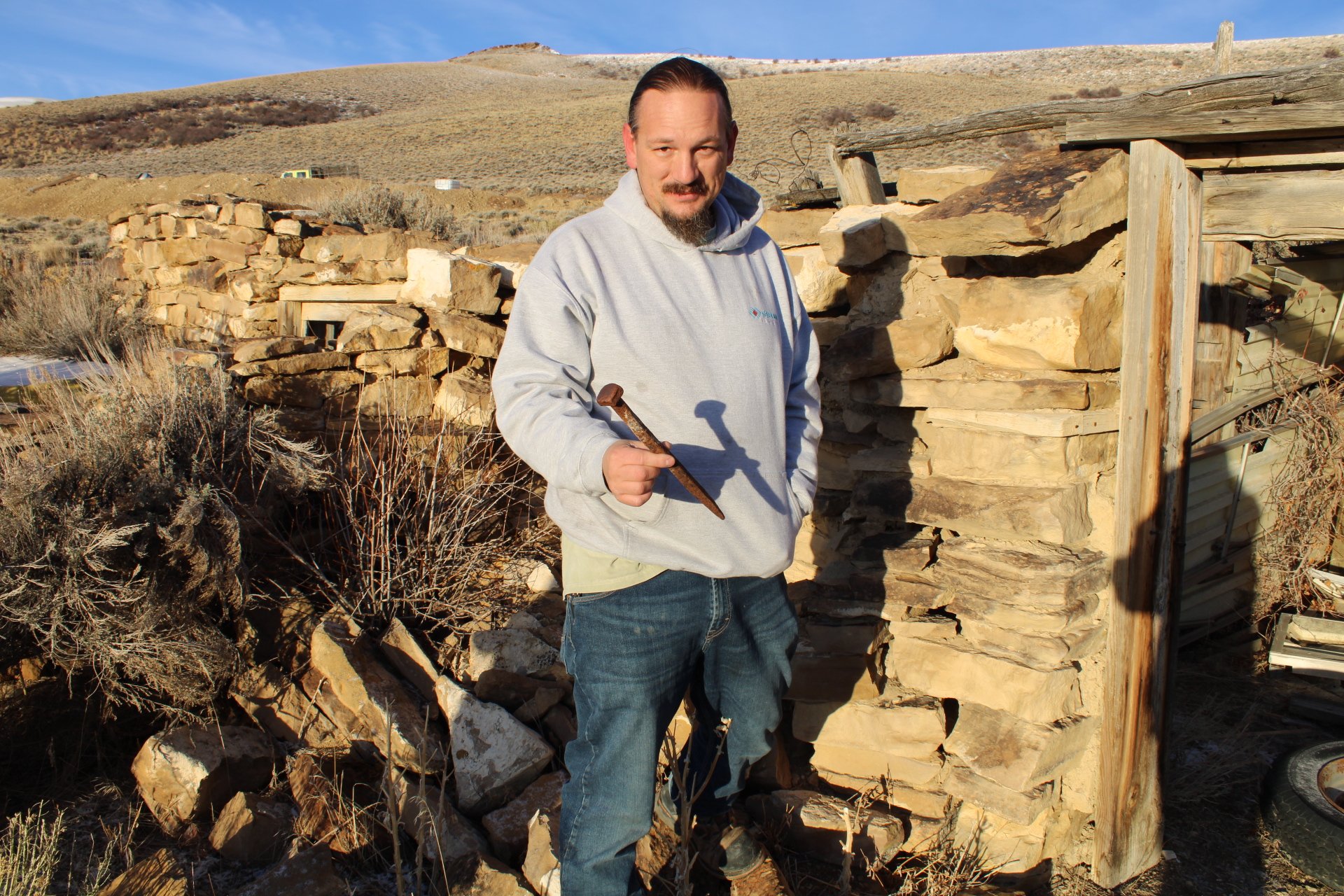
But actually the rest of his off grid neighbors all use solar panels like he does. They’re just cheaper and more reliable than wind generators. After that, Casey leads us down to the pond. Cottonwoods grow around the edge. This property used to be a park and later a gun club. And before that, it was someone’s homestead. Like the original earthship –it’s a little house built into the side of the hill. We hike up to check it out.
“So yeah,” Casey says. “You can see where the creek runs from the spring down comes right next to the old homestead house, and then it comes in here. Most of the year this is overflowing.”
“Good little stream too. Looks like it's a very strong spring,” I say.
“And that's the dream, right,” Casey says. Is that I'm gonna get some work done and get to a point where I can just put a nice little swing out here and listen to the creek babble and not work all the time. But yes, you gotta work hard to not work hard.”
Casey had an archaeologist friend come take a look at it to figure out when the little house was built and whether it was someone’s home.
” It's all stacked stone with local mud. Other than the big timbers that wouldn't have been anywhere near here, and it's got three rooms to it.”
Casey feels like living off grid on this land is part of a long tradition.
“ Three generations of home here, I think.”
But even as hard as he works to build this life for his family, he doesn’t dare compare himself to the original homesteaders that chose this spot.
“ Do you feel like you have a connection to that feeling of being sort of a pioneer or like a settler?” I ask. “Living out here where a lot of people would be like, well, you're crazy.”
“I'm part of like homestead groups and stuff and a lot of people throw that term around,” Casey says. “I give a guy at work grief all the time because he's always like, oh, out at my homestead. He lives out in Mountain View in the valley. And he lives in a subdivision that was divided by a contractor and he built a house and it's three acres or something like that. It's such a disservice to the people – there was somebody in pre-1918 that came out in the middle of absolutely nowhere, found a spring and put down roots to the point where they actually used the Homestead Law to do this. And when you're sitting there picking out stuff on the internet and having Amazon deliver it, you're doing a different thing than they were.”
But personally, even with Amazon deliveries, I think Casey might be on par with those original settlers in some important ways. We tromp up to the site where he’s building his log home. Last year, with only a little help from his brothers, some babysitting help from his mom, and a small tractor, Casey poured his cabin’s foundation. We stand inside and I can start to see his vision for the place.
“We're not really sure how functional Gracelynn’s gonna be. She has Down syndrome, she has some underlying medical conditions. I’m just not positive how independent she's gonna be. So when I was looking through plans, I found one that had – it was a log cabin with what they call the bunkhouse. It was supposed to be a hunting cabin, had a bunk underneath. And I looked at that and I said, well, I can build that into the hill, into the land. Dig it down. So it's gonna be structured so there’s this footprint that we're looking at here will be an apartment for her when she gets older.”
“Oh, that's amazing,” I say.
“So we'll have a walkout basement right in here. There's gonna be a walkout door, there'll be a bedroom back here, a little kitchenette, and then a living room. Depending on how independent she is, she can have her own living space. A little bit of autonomy in that but still be close enough that I can keep an eye on her and help her.” ere’s the thing that off gridders share with the original pioneers – we’re all dreamers. If Casey was still living in that house in town, it’d be a lot harder to dream of building an apartment where his daughter could be close by and still independent. That ability to dream is what this housing crisis is taking away from people. But off gridders like Casey, they found a different route. Sure, making this happen isn’t so easy….
“ The first summer all I got done was the septic system because my wife was in rehab that whole year. So the whole summer, it was just me and the kids and she was in rehab. But I did get the septic done that year. And then this year I thought I'd have some help. But then, we split and so it was still just me and the kids. And I got the foundation dug out. So this was one summer's worth of work – dig this out. Pour the concrete footers and start putting gravel in. And it's all done with this little 20 horsepower tractor.”
Casey says he thinks a little hardship has been good for his kids. Especially Thane.
” He's had a tumultuous life. His entire life has been issues with his mom and now his mom's not around. So, yeah, I think it'll take him a little while to really settle into what it's gonna look like out here. But I mean, he's super excited. Whenever I'm working on the house, he wants to be up there in the middle of it.”
Casey’s mom isn’t so sure about raising her grandkids out here where the snow drifts four or five feet around the mobile home, so high that he has to dig a tunnel to the car.
“But the majority of people I talk to, the overwhelming sentiment is, oh, I wish I could do that. Right? Everybody's looking for a little bit of freedom, a little bit of autonomy. I think that's what people yearn for. It's the essence of the American spirit, right? The American dream was a house, two and a half kids, picket fence in the front yard and stuff. But what that represented at the time is you had your own spot and it was yours.”
Against all odds, Casey is making a home for his family on the edge of a new kind of frontier where homes are harder and harder to come by. Before releasing this episode, I reached out to see what progress Casey has made on his log home. He already has the walls up on Gracelynn’s lower floor apartment. He says he’s quote “making progress all the time, and loving the life.”
MUSIC CREDIT: Chiado by Jahzzar is licensed under a Attribution-ShareAlike 3.0 International License.
We journey into the Red Desert of southwest Wyoming to visit a trona mine worker building his dream cabin off grid for the two small children he’s raising alone. He had to buy extra solar panels for his daughter’s medical equipment and the cabin includes an apartment where she can live with him when she grows up. He says it’s all part of his American dream.