
Cheap Dirt: The Teeny Tiny House
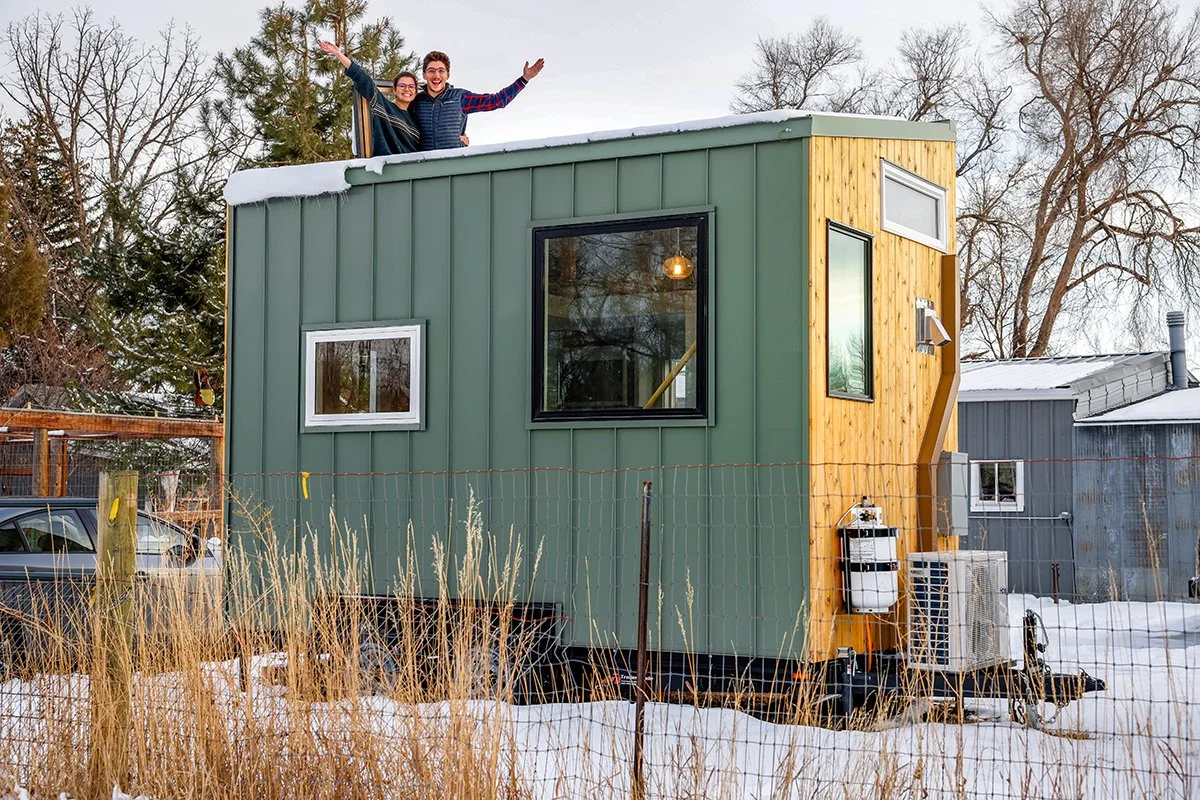
The Teeny Tiny House
It’s not easy finding Eric and Erica’s tiny house. It’s hidden out of view of the highway. To find it, Eric has to walk out and wave me down on a busy street in the shady outskirts of Fort Collins, Colorado. My producer McKenna Lipson is manning the mic and camera today and meets up with us too.
“Yeah. I'm Eric Forbes.”
“And so we're kind of walking down like a little path here. Is this part of the property that you live on?” I ask.
“So, this is like an office building that the owners run their business out of,” says Eric. “And then, there's the house back there, and then luckily it's on a bigger lot. And then as we come around the corner, we might have to weave through some cars here. We'll come up on the tiny house and our chickens.”
We walk around a big two story house that’s been partially converted into a business. Behind it, a large lot opens onto pasture land with plenty of cottonwoods hanging over.
“It’s beautiful back here,” I say.
“Little rustic kind of Americana,” Eric says.
“So is there like multiple little houses kind of going on back here?”
“There is an RV trailer that one of the business workers lives out of currently.”
We pass several other buildings out here, sheds and barns. But then I spot it – the tiny house. Just as adorable as you imagine. Very modern, a little boxy, with beige siding, stylish angles and lots of big windows. Or maybe I should say, the windows look big on such a small structure. Right outside the front door is the chicken coop. He introduces me to the flock.
“ So this one right here, this is Pepper. And then this is, Hey. Hey. And then the other orange one's Chicken Joe. And then that's Black Betty. And then the loud gray one, that's Chicken Nugget. And then the two littler gray ones are both her hatchlings and so that's Dino Nugget, the darker gray one. And then the other one, the light gray one is Houdini who liked to escape when she was a chick, so. Yep.”
Then we meet his partner.
“ And then this is Erica,” Eric says. “So Eric and Erica, I know.”
“Hello,” says Erica.
“We're the co-owners,” says Eric.
“Hello, I’m Melodie.”
“Nice to meet you,” says Erica.”
“Nice to meet you,” I say. “Do you wanna give us a tour?”
“Yeah. Come on in,” says Eric. “It's only 14 by eight feet. So it's one of the smaller tiny homes that we've even seen at tiny house festivals. But it has everything that we need. We got probably a bigger range than most tiny homes.”
“Oh, really?” I say. “Yeah, that seems like a pretty good sized stove.”
Plants and knick knacks sit on a window sill next to a cute little table.
“This is kind of our main little workspace or dining space and stuff,” says Eric. “And then we also can use the computer as a little bit of an entertainment center. And then there's a restroom and shower.”
“So this is the bathroom here?”
“I'll let you guys kind of go and you can go in,” says Erica.
“And so it's kind of got like a shower door and then the toilet is inside the shower, essentially?” I ask.
“So it's like a wet shower or wet bathroom, I think they called it,” says Erica.
A washer and dryer is tucked under the stairs. And up a curved staircase is a second floor where they sleep.
“ Is it okay if I look upstairs?”
“Yeah, feel free,” says Eric. “It is a crawl on the top, but you can get a good look.”
“I see what you mean,” I say. “So you've gotta kind of crawl over to get to your bed there.”
There’s no standing up. It reminds me of our bed in the loft in our geodesic dome. Can’t do much else up here except sleep. But they’ve embraced this simplicity.
“You know, you always kind of have to be in a downsizing phase,” says Eric. “It starts to clutter up fairly quick and it's like, okay, what are we not using anymore? And she really wants me to go through all my clothes. And she's like, ‘I haven't seen you wear that shirt in forever!’”
Most tiny homes are bigger, more like 14 by 10 feet or larger. Keep in mind, that’s only about as big as some people’s bedrooms. But with the four of us, it’s really not as crowded as you’d think. In fact, it’s cozy and tidy and uncluttered. Art hangs on the walls. Colorful fiestaware sits in the wood cabinets. Can I imagine living in this tiny house myself?
Oh, for sure, I totally can.
And I’m not the only one drooling over tiny houses. In a recent survey of Americans conducted by the financial company Fidelity, over half of respondents said they’d live in one…and cited affordability as one of their main reasons. It’s an especially attractive option to Westerners – which isn’t that surprising considering that we also have some of the worst housing shortages in the U.S. The survey showed that several of the states where tiny houses are the most popular are in the west. In fact, Wyoming is fourth. Idaho and Montana are sixth and seventh. Meanwhile, Idaho has the most tiny house listings on the market… Utah and Colorado aren’t far behind.
But what exactly are people signing up for when they buy one? Well, a tiny house is usually around 10 times smaller than a regular house…that’s about 225 square feet. That’s only about the size of my kitchen and dining room. But are they 10 times cheaper than a regular house? Nope. On average they’re about 38% more expensive to build per square foot than a regular sized house.
But Eric and Erica, they didn’t have to spend all that. They got super lucky. They won this house in an auction. That was about three and a half years ago when they were finishing their masters at Colorado State University. Eric was living in an apartment with two other roommates and Erica was still living at home with her parents. Now they have full time careers.
“I'm a filmmaker,” says Eric. “I do documentary stuff for Colorado State University and their Center for Science Communication pretty often. But also do my own narrative kind of stuff. Erica does some really cool sustainable stuff.”
“I work at CSU,” says Erica. “I do communications for a research collaborative in the Department of Animal Science.”
But even with these stable jobs, it’s hard to afford a house. Colorado has one of the worst housing shortages in the country. Almost 80 percent of low income renters are severely cost burdened here. In Fort Collins, in just eight years, the price of buying a house has doubled. Erica really wanted to move into her own place. But she had no desire to rent.
“It just feels like you're not moving forward,” says Erica. “You're not getting something out of it, and it's never really yours.
Eric was taking art classes across the street from the Richardson Design Center on campus and he kept noticing this tiny house getting built by students.
“So I'd walk out and I'd see it every day and we're like, oh, what's that? And we were kind of, we've talked about tiny houses previously before and stuff and watch some tiny house shows and stuff like that. So we kind of like, we're kind of looking at it.”
A university program was building tiny houses as a miniature version of a regular sized house as a way to teach construction skills. Then they’d sell it to build the next one.
“So yeah, they put it up for auction and they had it open so like during homecoming with the football games and stuff like that, they had it out there and people were coming by,” says Erica. “And then we put our bid in and they had it all online so you could track it. So we bid $31,000 initially and then we were winning this entire time, like we were doing so great. Every day, we'd check it. And then still we're winning. And then the night before the thing closed, someone bid for like $45,000. And we were like, what? Like, that's such a huge jump! So what we did is, we were like, okay, what if they meant to say $35,000 and they emailed the people wrong? So we came back in with a counter offer of $36,000. Like If this is wrong, like if this was like an accounting error, like we want to come in at this point.”
“And the bidding had closed,” says Eric.
“Everything was done,” says Erica. “And we didn't really see anything.”
“So you kind of thought you had lost?” I ask.
“We thought we had lost, because we couldn't go past the $45,000,” says Erica. “$31,000 was already us being like, eeeeh!. But then like the $36 was like just a last minute thing. We were buying scratch lottery tickets the night before it closed.”
“Hoping we could win an extra couple grand to do something,” says Eric.
“But then, it was funny because I was dog sitting for a family friend in Loveland and we got an email at the same time,” says Erica. “And it said, the subject line was, congratulations, you won the tiny house. And we called each other at the same time to the point where our phone calls canceled because we were trying to call each other. But yeah, it was pretty cool.”
So they got a tiny house for $36,000. That’s on the very low end of how much they usually cost. I saw some in Fort Collins for $100 grand! But Eric and Erica still had a big hurdle – one I saw mentioned often in tiny house circles. They now had to find land to put it on.
“When we won the bid and we knew we needed to find a place like that was, I think, the most stressful part of the entire process,” says Erica.
It took them a couple weeks of working their connections to find a location. They had a house but no land and finding cheap lots wasn’t so easy. For one thing, they couldn’t live anywhere inside the city limits.
“As of a few years ago when we were looking, a tiny house would be considered a dwelling, which is basically what an RV would be considered,” says Eric. “And if you lived out of that for more than half of the year, then that would be some violation.”
“So if there's a permanent structure in Larimer County, you can have RVs or whatever,” Erica says. “I guess essentially what they're wanting to avoid is people buying land and then just living on that land.”
Eventually a family friend agreed to rent them this space.
“ It can be pretty expensive. It can be $500, $700 kind of thing,” Eric says. “Luckily we have a very unique situation, And then of course we can split it, so. But it is very affordable so that's great.”
They’ve dreamed of buying a piece of mountain property and putting the tiny house there while they build something bigger.
“We've had a couple of times of like, oh, what if we moved or something and were like, oh, there's like a tiny house community in the mountains and then it's like, oh wait,” Eric says. “There's that and then that, and then it starts to get kind of unreasonable.”
So they’re sinking roots here for now. Their only costs are rent for the land and utilities. They’ve paid off their loan for the house and are making serious progress on their college debt too. And they’ve traveled the world while they were at it. And they’re not the only ones. I talked to another guy who’s made a business of promoting this lifestyle.
Ryan Mitchell is the founder of The Tiny Life dot com and has lived for years in a tiny house he built himself out in Charlotte, North Carolina. We heard from him earlier in the season. I interviewed him because he has useful insights for Westerners interested in what he calls “the minimalist life.”
“I never thought of myself as a minimalist until someone called me a minimalist,” Ryan says. “And I'm like, No, I'm not. And they were like Ryan, you live in 150 square feet, you absolutely are. You can count every single physical item that you own. You absolutely are minimalist. And then I had to concede the point. And so then I started researching and looking into a little bit more, and that's when I started kind of adopting some of the other things of the mindset, the lifestyle, and that positive feedback loop. Every time I did something, even if it was small, my life got better and that was a really great place to be. So it kind of became this flywheel.”
But he’s seen that it’s a lifestyle that people seem drawn to when times get tough. When the economy worsens, there’s more traffic on his website as people start scrambling for cheaper places to live.
“I can kind of have a pulse on what the collective consciousness is around housing and costs and cost of living and things like that, just by looking at my traffic metrics. Housing costs are a really big thing that are on a lot of people's minds. They were already tight in cash, like, barely making ends meet, and then rent goes up, and then it goes up a lot.”
He says it’s disturbing to see people forced into this way of living instead of choosing it.
“My hope for people is that you have the economic wherewithal to live the life that you want to live. And if that happens to be one that you choose to be a tiny home or minimalist life, then great. It's when people are kind of forced into it because of the economic matters that it's worrying.”
With his website, he tries to help bridge that divide for people. Because he’s definitely known that hardship himself.
“ In 2008-09, the Great Recession happened,” Ryan says. “I lost my job in that process. And was luckily able to get a new job pretty soon after that, which wasn't the case for many folks. But all this took place and it was a good time for me to kind of reflect and think about, okay, now that I'm literally at the beginning of my career, what do I want that to look like? What do I want my life to look like?”
So he started brainstorming.
“When I looked at my budget, about half my income was going towards rent, utilities, insurance, those kinds of things. And I kind of asked myself, what if, – and it was kind of a crazy question, – what if I could just eliminate that line item?”
So with his own two hands, he started building a miniature home for himself. At the time, it cost him around $35,000. He recognizes that some people don’t have those construction skills or that kind of cash.
“It seems like the people who are most successful are able to self-fund it. Most people don't have 35, 40, 50, $60,000. So it's a serious cost.”
Like Eric and Erica, he also lucked out and found a cheap piece of land where he could put his house.
“ I basically had met someone through an environmental meetup group in my city. And I knew that he had this extra parcel of land. One day, in kind of just a bold move, I said, Hey, would you be interested or open to me coming and I expect to pay rent? And he was really thrilled because it was a parcel of land he owned in another part of the city that he just couldn't get to and he wanted someone to just kind of keep an eye on it basically. So he's like, honestly, if you put in a driveway and you're willing to keep an eye on the place, then, I won't charge you any rent.”
Now he had the house, the land and very few bills. All this affected his lifestyle in a radical way.
“My bills went from $1,500 a month to about $15. One, five. Which is a huge difference, right?”
He paid about $8 for water per month and $5 for propane
“In the process of four years, I was able to pay off my student loans. So at that point I was debt free. So there wasn't a lot of bills. And then the bills I had, they were very low cost.”
But like lots of us who go off grid, Ryan was making this work by cutting some corners.
“I just want to be really clear. Like, my tiny home is illegal. Like it comes with risks, potentially consequences. In Charlotte, it would be like a $200 fine if it after like seven warnings or something. So I decided to chance it and, so far, we're now 10, 11 years in or something like that, I’m glad that I did.”
Essentially, he hadn’t built his house to code – he declined to get more specific than that. But he knew the city had bigger fish to fry and would turn a blind eye. It’s a theme I heard often talking to off gridders. I started to think of it as the blind eye policy. Rather than actually solve the affordable housing shortage, many communities just let people live outside the regulatory system. Ryan took full advantage of this loop hole. He used his tiny home as a stepping stone to a regular house.
“Because I was saving so much with my tiny house, I was able to save up a lot of money. Then I was able to purchase some land with that. So I own that land outright.”
Ryan is now building a 1700 sq foot house. That’s the size of any smaller house and definitely not tiny. Ryan believes tiny homes could help fill the gap in the affordable housing crisis in the U.S. Through his website, he’s seeing progress. For instance, more communities are letting people build them on their property.
“A lot of cities have provisions for what's called an ADU, an accessory dwelling unit. And what that basically is, is a secondary home that's placed on the same lot as a primary residence. Sometimes they're called granny pods or in-law suites.”
He says some cities might need to make changes to their building codes or zoning provisions to accommodate these ADU’s.
“You could bring in a tiny home on a small urban lot, put it in the backyard and suddenly you have doubled the occupancy or the housing on just that single lot.”
He said this could really help some demographics hit especially hard by the housing shortage. Like older people.
“That can really change your whole financial picture for retirement. So someone who's like, I'll never be able to retire, suddenly it's like, actually, I could.”
So is it really viable to scale up this whole tiny house concept to fill the gap in affordable housing? I wanted to know. So I reached out to one community development director, Bill Almquist. He works for a town where they actually tried using tiny homes as an affordable housing solution – Salida, Colorado. Like places across the west that have seen a surge in population in recent years – especially during the pandemic – Salida has grown too big for its britches. Bill says 15 years ago, you could still buy a house there for under $200,000. Now the average price according to Zillow is $700,000. He says that’s becoming a disincentive for local businesses.
“They started to realize that we didn't have much for the workforce around here,” Bill says. “We hadn't actually built a new apartment complex for something like 25 years. And that put us at a significant disadvantage when it came to staffing for the businesses around here who were struggling to keep up as the population started to grow. And we continued to see greater and greater tourism and there just weren't any other places for people here, employees specifically, to live.”
Salida’s hospital staff, its childcare providers, its restaurant workers, they couldn’t afford to live there.
“You see a number of people kind of congregating in the same units together, 6, 8, 10 people at a time, and like a three or four bedroom house.”
Or they just forego a roof altogether.
“We have lots and lots of forests around us and there's a lot of people in the warmer months who live out there.”
…Opting to camp out rather than give most of their paycheck to rent. So Salida decided to start experimenting. First, they tried providing a parking lot where people could pay a small fee to live in their cars in exchange for a porta-potty and trash pickup. But… that didn’t work.
“What we found is most people didn't really wanna be the center of attention,” Bill says. “They wanted to have a little bit more flexibility coming and going, and they would rather live out in the woods than live basically, in a parking lot in the middle of town.”
Next, they bought some RV’s and rented them out to people. Families even moved in. But the city had a bunch of trouble keeping them liveable.
“There's a lot of upkeep for those things. I spent many a cold evening trying to thaw out sewer pipes and water lines myself because we just didn't have anybody else to do it. It was, yeah, a lot of work and beyond our capacity, and we eventually ended the program last year, and ended up selling the majority of those RVs.”
But Salida might be most famous for approving the largest tiny home community in the U.S. called Sprout Tiny Homes. This time there was real hope.
“It went through all the various entitlement process, eventually got approved by city council and by the time that the owner started engaging with the manufacturer of those tiny homes and got some price quotes along with the infrastructure that was needed to put in, because there was no water or wastewater service to the area, it was determined that it was just cost prohibitive. They weren't able to actually do what they wanted to do. So that property sat vacant for several years and then was sold to some folks who decided to make an RV resort out of it.”
Bill’s take away after all these affordable housing experiments?
“It was nice to try to create some things outside the box. But ultimately people need stable housing. They need a real roof over their heads. And if you have land to be able to do that on, then you can't even get more creative with the types of housing that you can be put together. But right now we're really focusing on quality, affordable housing.”
Bill says now they’re putting their creativity into raising money to supplement the cost of building multifamily housing…and overcoming the entrenched “not in my backyard” attitudes. It’s a laborious process but he doesn’t think cutting corners with things like tiny home developments really works. In the meantime, Salida is practicing that same “blind eye policy” when it comes to RV’s and tiny homes on wheels.
“We do have rules on the books about not living in RVs, but we're not out there actively looking for those situations or trying to chase people away unless it's really shown to be an issue.”
ME: Eric and Erica say Fort Collins is doing the same thing.
If you even just look around this neighborhood, there's probably like five or eight different tiny homes sprinkled around different places, all in kind of a similar situation of a back lot kind of thing,” Eric says.
As long as those homes stick to the suburbs, the city overlooks them. Eric says this isn’t fair for people turning to tiny homes and RV’s for affordable housing because they’re forced to commute long distances, adding to their cost of living. Erica says the misconceptions about tiny homes run deep.
“My parents are always like, when are you moving now?” Erica says. “Like, when are you getting a real house? I was like, it is a real house. And it's a real house that I own, thanks.”
Eric says until those real affordable housing solutions are implemented, tiny homes are working for people like them and communities should find ways to support them.
“I think that should be a thing that people should be more encouraged to do is find creative solutions for their own living style,” Eric says. “Instead of being stuck in these rigid kind of things or buying a townhouse for a half million. Like that's something that would be just, ugh, I couldn't even imagine being in that much debt to be in that and not have something that’s your own.”
I ask them the question I’ve been asking most people. Did they choose a tiny house more as a financial choice or for the lifestyle?
“ I like the lifestyle,” says Eric. “I mean, I'm fine downsizing or whatever, But like what really is the driver now is that economic kind of thing. Especially with us fully owning the tiny house and paid off our loans for it and everything like that, and so that economic standpoint is, I would say more that thing that keeps you in it.”
They haven’t saved as much as they’d like toward some land where they could put the tiny house while they build a regular home – their ultimate goal. But Eric says he doesn’t think they’ll ever sell it. They’ve grown attached like you do with your first car. I understand that feeling well.
I can see it. I took our geodesic dome that we were living in and turned it into our greenhouse, so it's in our backyard. So I would never part with it. It was part of my life and who I am. And everything I've done in my life has kind of stemmed from that crazy lifestyle that I led during that time.
“Yeah, I think even if we ever moved out and we needed to keep it somewhere,” says Erica. “Like we would try to rent out like a big garage to put it in or something, just because, yeah, it's a little too special to give up.
MUSIC ATTRIBUTION:
20/20 (Instrumental Version) by Josh Woodward is licensed under a Creative Commons Attribution License.
She Dreams in Blue - Instrumental by Josh Woodward is licensed under a Attribution License.
Crazy Glue (Instrumental Version) by Josh Woodward is licensed under a Creative Commons Attribution License.
Invisible Light (Instrumental Version) by Josh Woodward is licensed under a Creative Commons Attribution License.